Gelagen Pantothenic Acid
JournalPantothenic Acid At 5.2 mg: What The Acne And Skin Studies Actually Tested
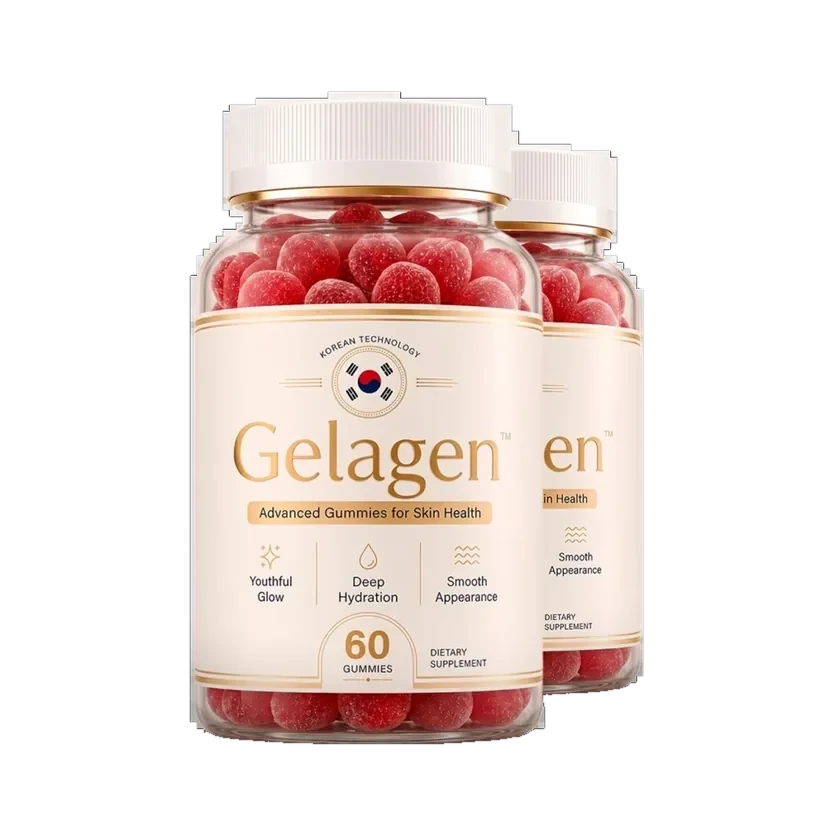
Gelagen prints pantothenic acid at 5.2 mg per serving, which is 104% of the 5 mg adequate intake. The best-known oral acne trial gave 2.2 g a day of a pantothenic acid-based supplement, about 420 times more, and the skin-barrier studies used dexpanthenol applied to the skin. Neither can be read onto this label. Deficiency is rare, so the row is a top-up on a reference intake, not a treatment.
What the label prints
Pantothenic acid is vitamin B5, and on the Gelagen Supplement Facts panel it is the ninth of thirteen rows: 5.2 mg per serving of two gummies, 104% of the Daily Value, with no form named beside it. The reference it is measured against is an Adequate Intake of 5 mg a day for adults, which the NIH Office of Dietary Supplements gives as the same figure for men and women from age 14 (ODS on pantothenic acid).
So the row is, almost to the decimal point, one day’s reference intake. The ingredients page makes the same observation, that pantothenic acid is the one amount on the panel that lands on its reference almost exactly. It is not a tiny trace, like the choline and inositol rows, and it is not a large multiple of a reference, like biotin. It is an ordinary amount.
That plainness is the point of this page. Pantothenic acid has a small literature connecting it to skin, and a reader who meets the word on a skin, hair and nails label may reasonably wonder whether the studies apply. To answer that fairly, the useful move is to read what those studies actually did, one at a time, and set each against 5.2 mg.
Deficiency is rare, and what that changes
Pantothenic acid is one of the most widely distributed vitamins in food. ODS puts it this way: almost all plant and animal foods contain it, and some of the richest sources are beef, chicken, organ meats, whole grains and some vegetables. Its main job is in the synthesis of coenzyme A and acyl carrier protein, which the body needs for fatty acid synthesis and breakdown and a great many other reactions (ODS).
Because it is so widely spread, ODS states that deficiency is rare except in people with severe malnutrition, and that when it does occur it is usually accompanied by deficiencies in other nutrients, which makes the effects specific to pantothenic acid hard to identify. The only people known to have developed a pantothenic acid deficiency were fed diets containing virtually none, or were taking a metabolic antagonist of it.
ODS also records that the Food and Nutrition Board could not set an upper limit, because there are no reports of toxicity in humans at high intakes. Some people taking large supplement doses, for example 10 g a day, develop mild diarrhea and digestive distress. That is a safety fact about very large doses, and it says nothing about whether large doses do anything useful for skin.
This matters for reading the 5.2 mg row in a specific way. For a reader who is not malnourished, a label amount at the reference intake is a top-up on something a normal diet already supplies. It is not a correction of a shortfall, because in the ordinary case there is no shortfall to correct. Nothing in that description makes the row a skin treatment.
The oral acne trial, in detail
The study most people mean when they connect pantothenic acid to acne is a randomised, double-blind, placebo-controlled trial published in 2014 in Dermatology and Therapy. Its authors tested what they called a pantothenic acid-based dietary supplement in adults who had been diagnosed with mild to moderate facial acne. The design was sound in outline: two arms, a matching placebo tablet, and a 12-week endpoint. The primary outcome was the difference in total lesion count between the groups from baseline to week 12 (Yang 2014).
Fifty-one adults were screened at two dermatology sites, 48 were enrolled and 41 were evaluable. At week 12 there was a significant mean reduction in total lesion count in the pantothenic acid group compared with placebo (P = 0.0197). Inflammatory lesions and quality-of-life scores also improved significantly, and the supplement was described as safe and well tolerated. On the face of it, that is a positive result.
Then comes the dosing, which is the part that matters here. Participants took two tablets twice a day with food, and the paper states that each four-tablet dose of the study agent contained 2.2 g of pantothenic acid. That is 2,200 mg a day, against 5.2 mg in a serving of Gelagen. Divide one by the other and the trial dose is about 423 times the label amount. The trial did not test a reference-intake amount. It tested a pharmacological one.
Three more details deserve to be stated, all from the paper itself. The product was a branded supplement described as pantothenic acid-based, and the text says it was verified by the manufacturer to contain the correct dosage of ingredients as listed, with the certificate of analysis not shown. The sponsor was the company that markets the product, Avilan Marketing LLC. And the authors listed their own limitations: a short intervention, a study powered to detect a difference in total lesions and not in inflammatory ones, and the possibility that milder non-inflammatory lesions could simply resolve by chance. Their conclusion was that further randomised, placebo-controlled trials were warranted.
None of that makes the trial worthless. It is a small, sponsor-funded, 12-week trial with a positive primary result, and it is exactly the kind of paper that a fair reader should note and then wait to see repeated. What it cannot be is a study of 5.2 mg.

The 1995 deficiency idea
Older writing on the subject is often quoted in place of trials, so it is worth being clear about what it is. In 1995 a paper in the journal Medical Hypotheses proposed a “radically different theory” of acne, suggesting that its pathogenesis relates to a deficiency in pantothenic acid, and that the effect of hormonal factors would become secondary to the availability of the vitamin. The abstract adds that the vitamin was hitherto not known to cause any deficiency syndrome in humans, and that a complete cure was effected by a very liberal replacement therapy with the vitamin (Leung 1995).
The abstract gives no dose and no figures, and the title of the journal is a fair description of the paper’s status. What the 1995 idea and the ODS description of deficiency have in common is a warning: if the theory were that acne is caused by too little pantothenic acid, then a reference-intake amount would be the wrong thing to test, because the Adequate Intake was itself set from usual intakes in healthy populations, according to ODS, so ordinary diets already provide about that much. The whole appeal of the idea rests on very large amounts. That is another way of saying that it is not about a label at the reference.
What the pooled review says
A better guide than any single trial is a systematic review, and there is a recent one in JAMA Dermatology. Shields and colleagues searched from inception to January 2023 for randomised trials of oral nutraceuticals, meaning vitamins and minerals, botanical extracts, prebiotics and probiotics, in people with acne. They found 42 trials with 3,346 participants. Studies of fair or good quality showed potential benefit of vitamins B5 and D, green tea extracts, probiotics and omega-3 fatty acids, mostly as fewer lesions or better investigator global assessment scores. Adverse effects were rare for most therapies, although gastrointestinal effects were reported for zinc. The review suggested a possible role for nutraceuticals in acne, noted that many studies were small, and called for larger trials (Shields 2023).
Two limits on how that can be used. First, the abstract names vitamin B5 among several agents without saying how many of the 42 trials tested it, at what doses, or in what product, so it cannot be turned into a statement about 5.2 mg. Second, the review is about acne, a specific skin condition. The Gelagen label is for adults who want skin, hair and nails support, and nothing on this page or the panel is an acne claim.
Dexpanthenol on the skin is a different experiment
The other body of pantothenic acid research in dermatology is not about swallowing it. Dexpanthenol is the stable alcoholic analog of pantothenic acid, and it is applied to the skin in creams, ointments and emulsions. A 2002 review in the American Journal of Clinical Dermatology explained that its topical use rests on good skin penetration and high local concentrations when it is given in an adequate vehicle. It described topical dexpanthenol as acting like a moisturizer, improving stratum corneum hydration, reducing transepidermal water loss and maintaining softness and elasticity, and reported double-blind, placebo-controlled trials in which epidermal wounds treated with a dexpanthenol emulsion regenerated faster than with the vehicle alone (Ebner 2002).
A 70th-anniversary review in 2017 covered the same ground with newer work. It described various studies confirming dexpanthenol’s moisturizing and skin barrier enhancing potential, and its use as a skin moisturizer or barrier restorer and as a facilitator of wound healing, while noting that the exact mechanisms of action have not been fully elucidated (Proksch 2017).
Everything in those two papers describes a molecule placed directly on the outer layer of skin, at a concentration the skin’s surface sees, in a formulation designed for penetration. A gummy is swallowed, digested and absorbed, and what reaches the skin arrives through the blood at whatever concentration the rest of the body allows. The two experiments differ in the molecule, in the route, in where it lands and in what was measured, and a result from one is not a result about the other. This is not a fine point. It is the difference between putting a moisturizer on a dry patch and eating a vitamin.
Study by study against the label
| Source | What was given | Route | Who and how long | Multiple of 5.2 mg |
|---|---|---|---|---|
| Gelagen panel | 5.2 mg pantothenic acid, form not stated | Swallowed, two gummies a day | Adults; no trial of the finished product | 1 |
| Yang 2014 | 2.2 g a day of a pantothenic acid-based supplement | Swallowed, tablets with food | 41 evaluable adults with acne, 12 weeks | About 423 |
| Leung 1995 | “Very liberal” replacement; no dose in the abstract | Not stated in the abstract | Hypothesis paper | Cannot be calculated |
| Shields 2023 | Many oral products; B5 among several | Swallowed | 42 trials, 3,346 participants across all agents | Not in the abstract |
| Ebner 2002, Proksch 2017 | Dexpanthenol, a stable analog | Applied to the skin | Wound healing and skin barrier studies | Not comparable |
The multiple for Yang 2014 is this page’s arithmetic: 2,200 mg divided by 5.2 mg. The other rows are left blank of numbers on purpose, because the abstracts do not print a dose that can be compared.
What can be said, and what cannot
What can be said starts with the label. It prints 5.2 mg of pantothenic acid per serving, which is 104% of the Daily Value and almost exactly the 5 mg Adequate Intake. Pantothenic acid is an essential nutrient involved in coenzyme A, it is found in almost all foods, and deficiency is rare. There is a small, 12-week, sponsor-funded acne trial at 2.2 g a day, a systematic review that names B5 among several promising but small-study agents, and a separate body of work on dexpanthenol applied to skin. The site itself states that Gelagen has not been the subject of a published clinical trial.
What cannot be said is any effect of the 5.2 mg. Nobody can say that it clears blemishes, softens the skin, thickens a nail or does anything for hair, because none of the studies above tested that dose, in that form, for that outcome. A result at 2.2 g a day does not scale down 423-fold by assumption. A result on the surface of the skin is not a result from the inside. And a labelled amount at the reference intake is an amount most people already get from food, so there is no obvious gap for it to fill.
That is not a reason to think badly of the row. A B-vitamin at its reference intake is a sensible thing to see on a multi-nutrient panel. It is only a reason to keep the claim the size of the evidence. Anyone dealing with acne that troubles them has better routes than a supplement panel, starting with a pharmacist or a dermatologist, and this page does not replace either.
Five questions to put to any skin trial
The pantothenic acid example is useful because it can be repeated on any nutrient printed on any label. Five questions do most of the work.
- What was the dose, in the same unit as the label? If it is hundreds or thousands of times larger, the trial is not about the label.
- Swallowed or applied? A topical result and an oral result are separate findings, even when the molecule has a similar name.
- Who took part, and for how long? A 12-week trial in adults with a diagnosed skin condition does not describe someone without it.
- Who paid, and what exactly was in the tablet? “Based on” a nutrient leaves room for other ingredients, and a sponsor with a product to sell is entitled to fund a trial but not to be its only reader.
- Has it been repeated, and what does the pooled review say about certainty? One positive trial is a starting point, and the reviews here all ask for larger ones.
Put through those five, the 5.2 mg row comes out as a normal amount of a normal vitamin, with no study behind it and none against it. That is a perfectly respectable thing for a label to carry. For the wider habits of reading a panel, the field-by-field walk through the panel is the place to continue, and the biotin post applies the same discipline to the label’s largest number.
- Yang M, Moclair B, Hatcher V, Kaminetsky J, Mekas M, Chapas A, Capodice J. A randomized, double-blind, placebo-controlled study of a novel pantothenic acid-based dietary supplement in subjects with mild to moderate facial acne. Dermatol Ther (Heidelb). 2014;4(1):93-101. https://pubmed.ncbi.nlm.nih.gov/24831048/
- Leung LH. Pantothenic acid deficiency as the pathogenesis of acne vulgaris. Med Hypotheses. 1995;44(6):490-492. https://pubmed.ncbi.nlm.nih.gov/7476595/
- Shields A, Ly S, Wafae B, Chang YF, Manjaly P, Archila M, Heinrich C, Drake L, Mostaghimi A, Barbieri JS. Safety and Effectiveness of Oral Nutraceuticals for Treating Acne: A Systematic Review. JAMA Dermatol. 2023;159(12):1373-1382. https://pubmed.ncbi.nlm.nih.gov/37878272/
- Ebner F, Heller A, Rippke F, Tausch I. Topical use of dexpanthenol in skin disorders. Am J Clin Dermatol. 2002;3(6):427-433. https://pubmed.ncbi.nlm.nih.gov/12113650/
- Proksch E, de Bony R, Trapp S, Boudon S. Topical use of dexpanthenol: a 70th anniversary article. J Dermatolog Treat. 2017;28(8):766-773. https://pubmed.ncbi.nlm.nih.gov/28503966/
- NIH Office of Dietary Supplements. Pantothenic Acid: Fact Sheet for Health Professionals. Updated March 26, 2021. https://ods.od.nih.gov/factsheets/PantothenicAcid-HealthProfessional/

Read the Gelagen label for yourself
Thirteen nutrients with an amount beside every one, and two gummies a day.
$49 to $79 a bottle
Order Gelagen