Gelagen Journal Two Smaller Doses, Not One
JournalTwo Smaller Doses, Not One: What The Twice-Daily Instruction Is Doing
Gelagen's own instructions ask for two gummies daily rather than one larger one. There is real published research showing that splitting a dose of a water-soluble vitamin can raise how much of it the body actually keeps — but the research also shows that effect only starts to matter at doses far higher than anything on this panel. At the amounts this label prints, the twice-daily instruction is doing less pharmacological work than it might look like, and more of the ordinary, practical kind.
The instruction printed on the label

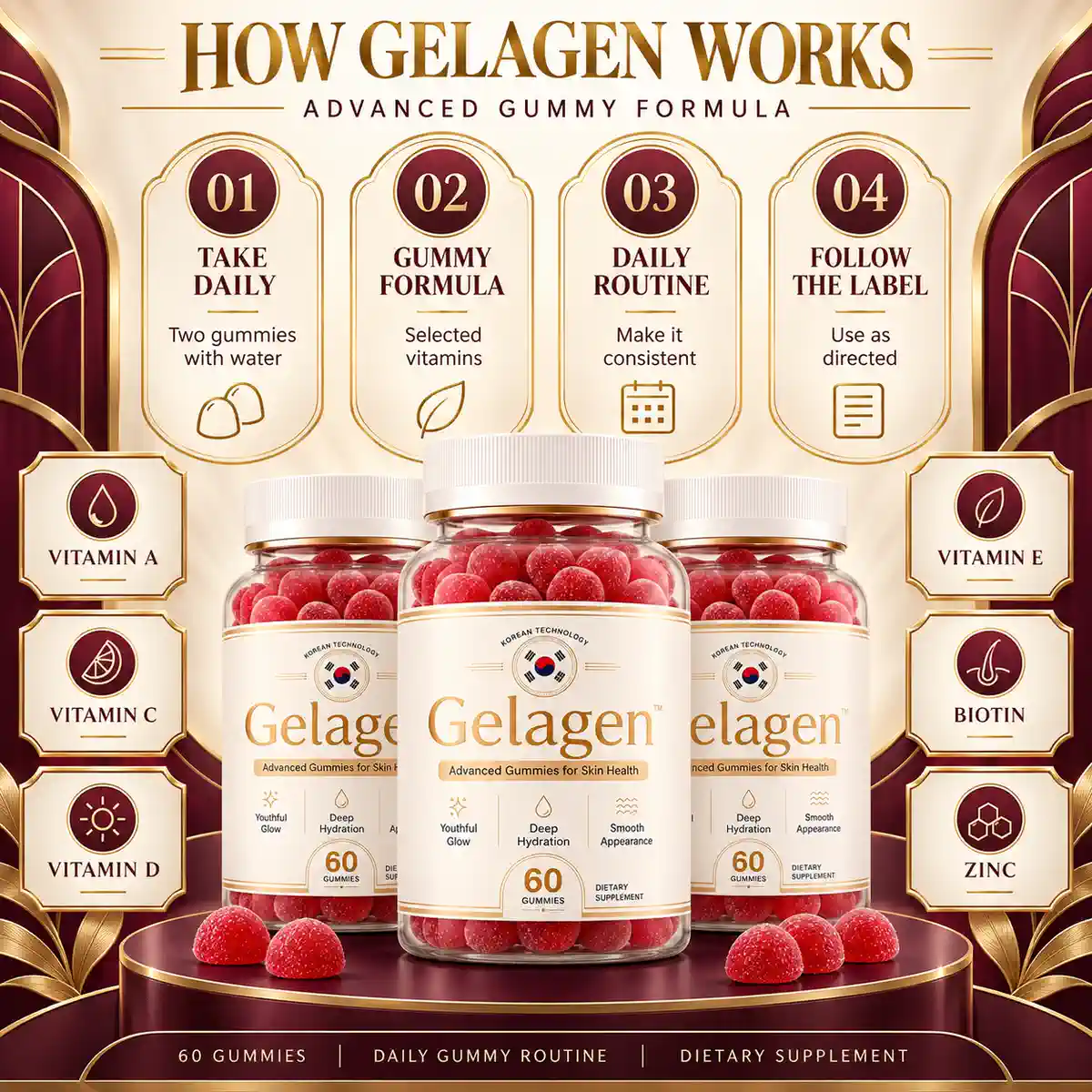
Gelagen's printed directions are specific: two gummies a day, taken with a full glass of water, about thirty minutes before a morning or afternoon meal. That is one serving, split across two pieces, not two separate servings spread across the day. It raises a fair question anyone reading a label closely might ask — does taking two smaller gummies together, or a single larger one, actually change how much of any nutrient the body keeps? The honest answer needs two different pieces of science, because "splitting a dose" means different things depending on which nutrient is being split.
It is also worth being precise about what this page is and is not asking. It is not asking whether taking the two gummies at different times of day — one in the morning, one in the afternoon — changes anything, because the label does not instruct that either way; it asks for two gummies daily, full stop, with a suggested window relative to a meal. What this page is asking is narrower and more useful: does the fact that a day's nutrients arrive as two smaller pieces rather than one larger one change how much of those nutrients the body actually absorbs, for the specific nutrients where that question has been studied.
Why "twice daily" is not automatically about absorption
It is tempting to assume every dosing instruction on a supplement label reflects a pharmacokinetic finding: that somebody ran the numbers and found the exact point where splitting starts to help. Sometimes that is true. Often it is not, and the only honest way to tell the difference for any specific label is to compare its actual amounts against the actual published research on that nutrient, dose by dose. That is what the rest of this page does with the two nutrients on Gelagen's panel that have the best-documented dose-response data: vitamin C and biotin.
What a six-month hospital study actually measured
The most detailed human data on how dose size changes vitamin C absorption comes from a study the National Institutes of Health ran in the 1990s. Levine and colleagues hospitalized seven healthy volunteers for four to six months, kept them on a diet supplying less than 5 mg of vitamin C a day to deplete their stores under controlled conditions, and then tested seven different daily doses ranging from 30 mg up to 2,500 mg, measuring steady-state blood and tissue concentrations at each one (Levine 1996).
What they found was a curve, not a straight line. Plasma vitamin C rose steeply as the dose went from 30 mg to 100 mg, then continued rising more gradually until it flattened out completely at 1,000 mg a day — the point of full saturation. At the level of a single dose rather than a daily total, bioavailability was complete for a 200 mg dose taken all at once. It was only at single doses of 500 mg and higher that the picture changed: less of the vitamin was absorbed, and the extra was simply excreted in urine rather than taken up. Based on that curve, the study's authors argued the RDA for vitamin C should move from 60 mg to 200 mg a day, obtainable from ordinary food.
| Single dose | What the study found |
|---|---|
| 30–100 mg | The steepest part of the curve; each extra milligram raises plasma levels the most here |
| 200 mg | Bioavailability complete; the first dose past the steep part of the curve |
| 500 mg and above | Bioavailability starts to decline; the extra is excreted rather than absorbed |
| 1,000 mg/day | Plasma concentration fully saturates |
Applying that curve to this panel's 20 mg
Gelagen's panel prints 20 mg of vitamin C per two-gummy serving — about 22 percent of the 90 mg Daily Value. Set that 20 mg figure next to Levine's curve and the picture is straightforward: 20 mg sits well below even the 30 mg point where the steep, absorption-sensitive part of the curve begins, let alone the 200 mg mark where single-dose bioavailability is complete, or the 500 mg mark where splitting a dose could plausibly matter. At 20 mg, whether that amount arrives in one gummy or is divided across two is very unlikely to change the fraction the body absorbs, because the amount itself is nowhere near the range where the saturable part of vitamin C uptake becomes the limiting factor. This is not a criticism of the number; it is simply outside the range where the twice-daily instruction would be doing pharmacokinetic work for this particular nutrient.
A different kind of doorway: biotin's transporter
Biotin tells a different, less numerically settled story. It does not cross the intestinal wall by simple diffusion the way some nutrients do; it is carried by a specific membrane protein called the sodium-dependent multivitamin transporter, which also moves pantothenic acid across the same route. Zempleni and colleagues, reviewing the biology of biotin and biotinidase deficiency, describe this transporter along with the enzyme biotinidase as the machinery governing how biotin moves from the gut into the body and through the bloodstream (Zempleni 2008).
A carrier protein is not an open door; it has a finite number of copies and a finite handling speed, which is the general definition of a system that can become rate-limited at a high enough single dose. What the published review literature on biotin does not supply is a precise milligram figure for exactly where that ceiling sits in humans at supplement-range doses, and this page will not invent one. What can be said honestly is that biotin's route into the body is carrier-mediated rather than a simple gradient, which is a mechanistically real reason splitting a very large single dose of biotin specifically could matter more than splitting a small dose of vitamin C does — even though the exact numbers are not settled in the literature the way vitamin C's are.
What splitting can and cannot change at these amounts
Putting the two nutrients side by side is the useful exercise. Vitamin C on this panel, at 20 mg, is nowhere near the dose range where splitting would change anything measurable, based on the most detailed human dose-response data available. Biotin, at 5,000 mcg, uses a carrier-mediated route that is mechanistically capable of becoming rate-limited at high doses, but the published literature has not pinned down exactly where that happens for a single oral dose in humans, so no specific claim can be made about whether splitting this panel's biotin amount changes its absorbed fraction.
That is a more careful answer than either "splitting always helps" or "splitting never matters," and it is the honest one available from what has actually been published and verified for these two nutrients.
It is worth extending the same logic to the rest of the panel briefly, even without a dedicated dose-response study for each one. Minerals like zinc and iodine are absorbed through active, transporter-mediated routes broadly similar in concept to biotin's, which means the same caveat applies: carrier-mediated in principle, but without a published single-dose ceiling this page can cite with confidence at the amounts this label prints. Fat-soluble vitamins — A, D and E, all three on this panel — follow an entirely different absorption route tied to dietary fat and bile rather than a saturable protein carrier, so the vitamin C framework above does not transfer to them at all. The pattern across all of this is the same one this journal keeps repeating: absorption science is nutrient-specific, and a general instinct about "splitting doses" does not travel cleanly from one nutrient to the next.
The more mundane reasons a serving comes in two pieces
None of the above rules out a simpler explanation for why a gummy serving comes in two pieces rather than one: manufacturing and mouthfeel. Fitting thirteen nutrients' worth of a full daily serving, plus the gelling agents, sweeteners and flavoring a chewable gummy needs, into a single piece can make that piece large enough to be unpleasant to chew. Splitting the same total into two smaller gummies is a common formulation choice across the gummy-supplement category generally, independent of any nutrient's absorption curve. A twice-daily instruction can also support a habit — one gummy with a morning routine, a second with an afternoon one — which is a behavioral argument for consistency, not a pharmacological one. A reader comparing formats across the category will notice that capsules, tablets and drops each carry their own version of this same question, and the answer is rarely a single universal rule; it is nutrient by nutrient and format by format, and the only way to answer it honestly for any specific product is to look up the specific published research the way this page has tried to for vitamin C and biotin.
Both of those are legitimate reasons a label might ask for two gummies instead of one. Neither of them is the same claim as "splitting the dose changes how much your body absorbs," and this page has tried to keep those two kinds of claims separate rather than letting one borrow credibility from the other.
There is a third mundane reason worth naming: dose-form consistency across a production run. A gummy manufacturer blending thirteen nutrients into a single matrix has to keep each nutrient evenly distributed through the mixture before it is cut and molded into individual pieces. Two smaller, more uniform gummies are, in practice, often easier to dose consistently at scale than one larger piece carrying an entire day's worth of thirteen different nutrients, some of them — like biotin at 5,000 mcg against choline at a fraction of a milligram — present in wildly different quantities within the same mixture. That is a manufacturing-quality argument, not a pharmacokinetic one, and it sits alongside mouthfeel and habit-formation as a plausible, mundane reason for a two-piece serving that has nothing to do with how the small intestine handles any individual nutrient.
What to do with a twice-daily instruction

See the full Gelagen label
Twenty milligrams of vitamin C, 5,000 mcg of biotin, and eleven more nutrients with an amount beside every one.
Order Gelagen- Follow the printed instruction — two gummies daily, with water, roughly thirty minutes before a meal — because that is what the label was written and reviewed against.
- Do not assume splitting a dose is doing absorption work unless the specific nutrient and the specific dose have been studied together, the way Levine's team studied vitamin C.
- For nutrients with carrier-mediated absorption, like biotin, treat "it could matter at a high enough dose" as an honest, unresolved statement rather than a settled number.
- Read the panel's other twelve nutrients the same way: the dose, the reference, and whether research has actually tested that dose.
- Levine M, Conry-Cantilena C, Wang Y, Welch RW, Washko PW, Dhariwal KR, Park JB, Lazarev A, Graumlich JF, King J, Cantilena LR. Vitamin C pharmacokinetics in healthy volunteers: evidence for a recommended dietary allowance. Proc Natl Acad Sci U S A. 1996;93(8):3704-3709. https://pubmed.ncbi.nlm.nih.gov/8623000/
- Zempleni J, Hassan YI, Wijeratne SS. Biotin and biotinidase deficiency. Expert Rev Endocrinol Metab. 2008;3(6):715-724. https://pubmed.ncbi.nlm.nih.gov/19727438/
- NIH Office of Dietary Supplements. Vitamin C: Fact Sheet for Health Professionals. https://ods.od.nih.gov/factsheets/VitaminC-HealthProfessional/
Read the Gelagen label for yourself
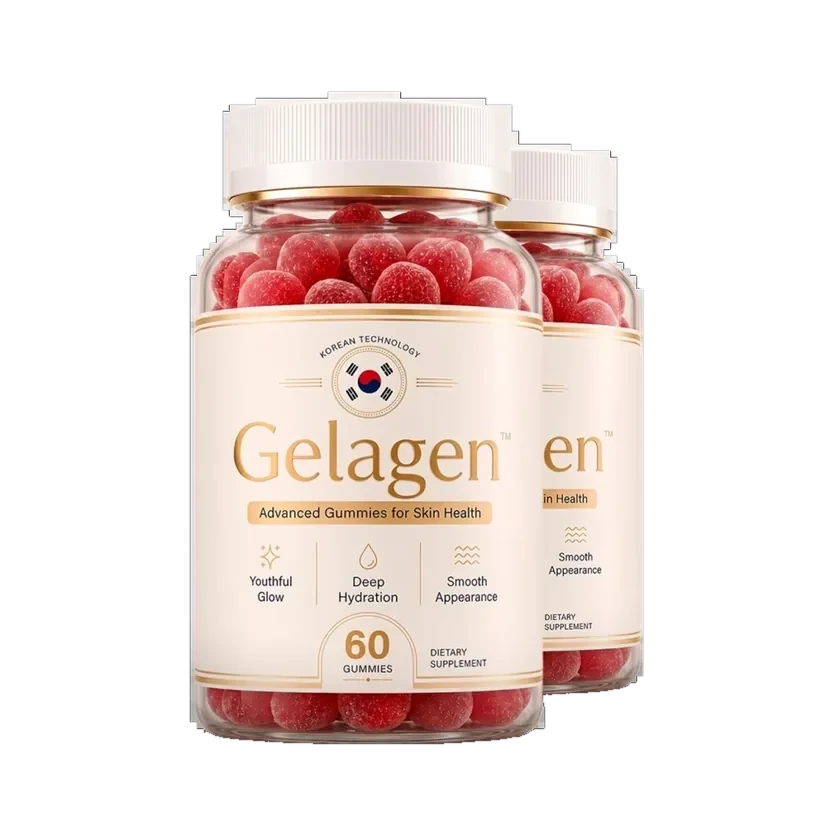
Thirteen nutrients with an amount beside every one, two gummies a day, and sixty days from the date you buy.
$49 to $79 a bottle · 60 days from the day you buy
Order GelagenFree US shipping on three and six bottles · 60-day money-back guarantee