Gelagen Official Website Names And Ingredients
JournalA Brand Name Is Not An Ingredient List
The name on a supplement jar is a trademark, not a declaration. The only description of the contents that is regulated is the Supplement Facts panel on the back, and checking it takes half a minute. This post walks through the gap between the two, using the ingredients people most often assume are present and are not.
What a supplement name is allowed to be
A supplement name is a trademark. Its job is to be distinctive and memorable, and the one legal constraint on it is that it must not be false or misleading. What it is not, and was never designed to be, is a declaration of contents.
The regulated description of what is in a supplement is the Supplement Facts panel on the back, plus the other-ingredients line under it. 21 CFR 101.36 sets out what that panel has to carry: a quantitative amount by weight per serving for every declared nutrient, with the percent Daily Value beside it. Between the panel and the other-ingredients line, everything in the jar is accounted for.
So a name is a question rather than an answer, and the answer is thirty seconds away on the back of the same bottle. This desk does not know how any product on this shelf came by its name and does not speculate. What it can do is show you where the answer lives.
| What it is | What governs it | What it can tell you |
|---|---|---|
| The brand name | Trademark law, which asks only that it not mislead | Nothing about the contents. It is a name. |
| The claim on the front | 21 CFR 101.93, which requires the disclaimer | How a nutrient is said to affect normal structure or function |
| The Supplement Facts panel | 21 CFR 101.36 | Every declared nutrient, with a weight per serving beside it |
Only the bottom row is a description of contents, and it is the one field that has to be complete.
Collagen research is about a different ingredient
The Gelagen panel prints thirteen nutrients: vitamins A, C, D, E, B6 and B12, folate, biotin, pantothenic acid, choline, iodine, zinc and inositol. Collagen is not among them, and neither is keratin or silica. That is an observation about a published label, it takes half a minute to confirm on the label page, and it is not an accusation about anybody.
It matters because there is a body of collagen research and people reasonably have it in mind. That research is about an ingredient this jar does not contain: de Miranda and colleagues pooled nineteen randomised, double-blind, controlled trials of hydrolysed collagen, taken as collagen, covering 1,125 participants aged twenty to seventy over about ninety days, and reported improvements in skin hydration, elasticity and wrinkles (de Miranda 2021).
Two cautions come with that literature even on its own ground. The field is heavily industry-funded and the review is positive throughout, so the fair phrasing is that trials of hydrolysed collagen have found these effects rather than that the question is settled. And a trial of one ingredient says nothing about a product that does not contain it, in either direction.
The thirty-second check that settles it
The check works on any bottle on any shelf and does not require you to know anything about the ingredient you are looking for.
- Turn the jar around and find the box headed Supplement Facts.
- Read the serving size at the top, so you know what the numbers describe.
- Run your eye down the left-hand column, which is the complete list of declared nutrients.
- Read the other-ingredients line underneath, which is everything else in the product.
- If what you are looking for is on neither, it is not in the jar.
That is the whole method, and its power is that it is negative as well as positive. A panel cannot quietly omit a declared nutrient, so the absence of a name from those two fields is informative in a way that the presence of a word on the front of the jar is not.
The true mechanism sentence people are reaching for
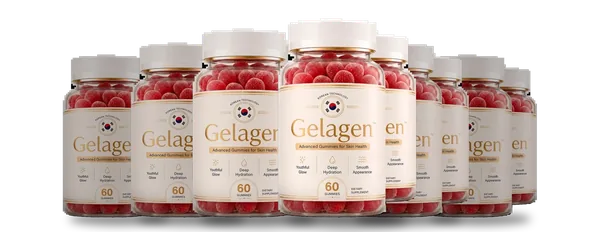
Gelagen on the official website
Thirteen nutrients, every amount printed, and the panel on the back rather than the promise on the front.
Order GelagenUnderneath the name there is usually a real idea, and on this shelf it is a good one. NIH states that vitamin C is required for the biosynthesis of collagen, and that deficiency impairs collagen synthesis and weakens connective tissue (the ODS fact sheet on vitamin C). That is a statement about how a body works. It is true, it is checkable, and it is not a statement about any product.
The Gelagen panel prints 20 mg of vitamin C against a Daily Value of 90 mg, which is about 22 per cent of a day’s worth. So the accurate sentence is that this panel contains a nutrient the body requires in order to make collagen of its own, at roughly a fifth of a day’s intake. The inaccurate sentence, and the one the category leans on, is that the product builds collagen.
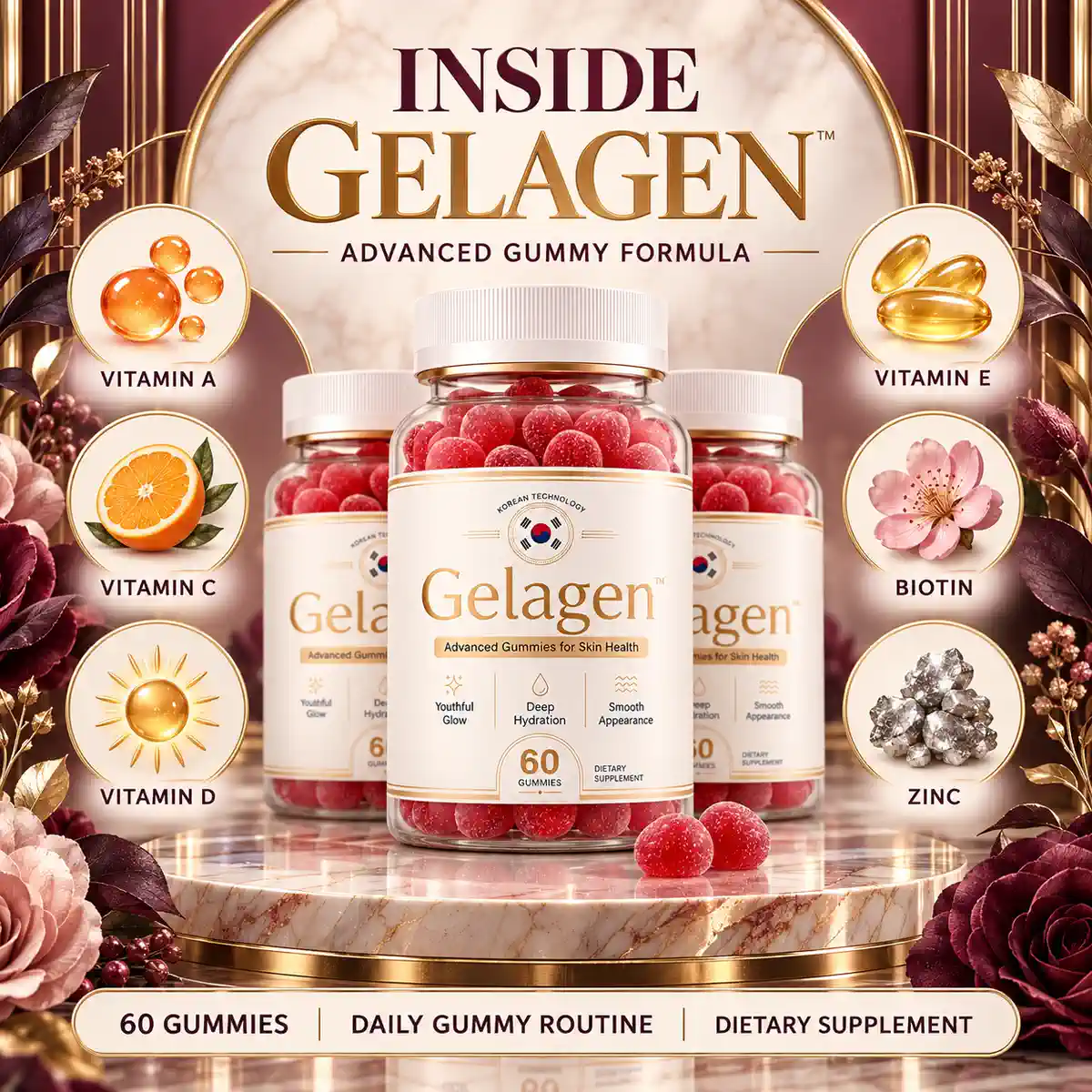
The seller’s own page says Gelagen supports skin radiance and firmness, hair and nails. Radiance and firmness is the seller’s wording and it is printed here as the seller’s wording: this desk found no trial of this product, and no trial of this particular combination of thirteen nutrients at these amounts, to set beside it. The mechanism sentence above is the nearest true thing, and it is about the body rather than the bottle.
| On the panel | Amount per two-gummy serving | What NIH says it does in the body |
|---|---|---|
| Vitamin C (ascorbic acid) | 20 mg | Required for the biosynthesis of collagen |
| Zinc | 2.7 mg | Required for protein and DNA synthesis and for wound healing |
| Biotin | 5,000 mcg | A B vitamin whose deficiency signs include hair loss and brittle nails |
| Collagen | Not a declared nutrient on this label | The hydrolysed-collagen trials are about an ingredient this jar does not contain |
The right-hand column describes what each nutrient does in a human body, from the NIH fact sheets. None of it is a claim about what this product does, and none of those sheets was written about it.
The rest of the front of the jar, and what it is
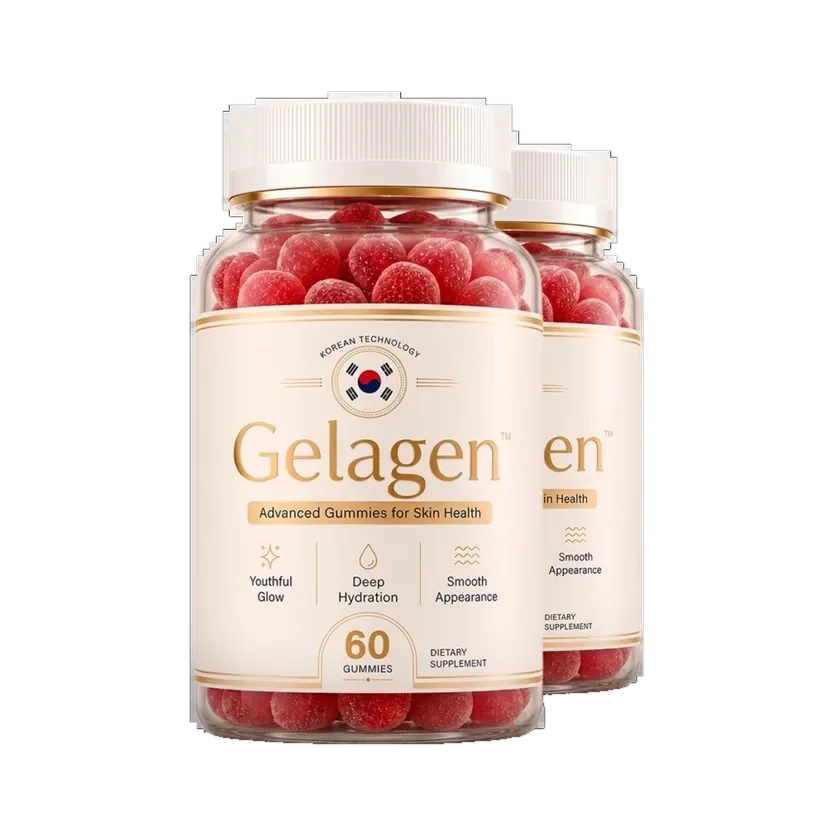
Beside the name, the Gelagen artwork carries three icon words, youthful glow, deep hydration and smooth appearance, and the line “Korean Technology” printed above a national flag. All of it is front-of-pack design.
It is fair to describe what a bottle says, and this website does. It is not fair to promote any of it into evidence. A phrase about technology on the front of a jar is not a manufacturing standard, not a sourcing statement and not a finding, and nothing in the seller’s material or on the label says where the product is made. Read it as artwork, which is what it is, and move to the back of the bottle for anything you intend to rely on.
The four seals on this pack get the same treatment. Three of them describe the plant and the sourcing and one is a promise about your money, and each is read for what it can and cannot prove on the testing and quality page. A seal is a claim like any other: worth knowing about, worth checking, and never a substitute for the panel.
Nothing on this page says Gelagen treats, prevents or cures anything. It is a dietary supplement, sold for adults following the label. Anyone who is pregnant or nursing, taking prescription medication or living with a diagnosed condition should speak to a clinician before starting it.
Three naming patterns on this shelf, and what each one implies
Walk a beauty supplement aisle and the names fall into a few shapes. None of these is a criticism of any product; they are patterns, and each one invites a specific question that the back of the bottle answers.
A name built on a structural protein
Names that echo collagen, keratin or elastin invite the reading that the protein is in the jar. The check is the nutrient column: proteins and peptides are declared like anything else, so if one is present it has a line and an amount.
A name built on a nutrient
A name carrying a vitamin invites the reading that the product is essentially that nutrient. Often there are ten or twelve more rows underneath, and those rows are usually where the product differs from its neighbours.
A name built on a place or a process
A name suggesting a method or an origin invites the reading that something particular was done. Manufacturing claims sit outside the panel and are not verifiable from a bottle, so this is the pattern that most needs the seller to publish something.
The survey evidence about this category’s labels is thin but pointed. One study of 176 skin, hair and nail supplements bought from seven stores found that most lacked independent testing, many used outdated Daily Values, and most made health-related marketing claims (Perez-Sanchez 2020). That is one shelf survey of other products and is quoted as that, not as a verdict on anything sold here. What it supports is the habit rather than the suspicion: check the panel, every time, whatever the name says.
Where the regulated words are, and what they may say
There is one part of the front of a supplement jar that is constrained, and it is the claim rather than the name. A dietary supplement may make a structure or function claim, describing how a nutrient affects the normal structure or function of the body, and when it does it must carry the disclaimer set out in 21 CFR 101.93: this product is not intended to diagnose, treat, cure or prevent any disease.
That disclaimer is doing more work than most readers give it credit for. It marks the boundary between the register a supplement is allowed to speak in and the register a medicine speaks in, and a product that crosses it is making a drug claim. Advertising has its own standard: the Federal Trade Commission expects health claims to rest on competent and reliable scientific evidence (the FTC’s health products compliance guidance). This desk does not issue a verdict on any seller’s advertising, and none is offered here.
The gap that leaves is the one this post is about. The claim is regulated. The panel is regulated. The name in between is a trademark, and the only way to close the gap is to turn the bottle over. On this product the full list is on the ingredients page, with the amount and the reference intake beside every one of the thirteen.
- 21 CFR 101.36 - Nutrition labeling of dietary supplements, published by Electronic Code of Federal Regulations → view on ecfr.gov
- Effects of hydrolyzed collagen supplementation on skin aging: a systematic review and meta-analysis, published by de Miranda RB, Weimer P, Rossi RC [Int J Dermatol, 2021;60(12):1449-1461] → view on pubmed.ncbi.nlm.nih.gov
- Vitamin C: Fact Sheet for Health Professionals, published by NIH Office of Dietary Supplements → view on ods.od.nih.gov
- Skin, Hair, and Nail Supplements: Marketing and Labeling Concerns, published by Perez-Sanchez AC, Tantry EK, Burns EK, Perez VM, Prabhu S, Katta R [Cureus, 2020;12(12):e12062] → view on pubmed.ncbi.nlm.nih.gov
- 21 CFR 101.93 - Certain types of statements for dietary supplements, published by Electronic Code of Federal Regulations → view on ecfr.gov
- Health Products Compliance Guidance, published by Federal Trade Commission → view on ftc.gov
Read the Gelagen label for yourself
Thirteen nutrients with an amount beside every one, two gummies a day, and sixty days from the date you buy.
$49 to $79 a bottle · 60 days from the day you buy
Order Gelagen On The Official WebsiteFree US shipping on three and six bottles · 60-day money-back guarantee · lot GEL-26/GE-6362